Why Won’t My uPVC Door Lock?
A simple step-by-step guide to help you find out why your uPVC door won't lock and what you can check before calling for help.
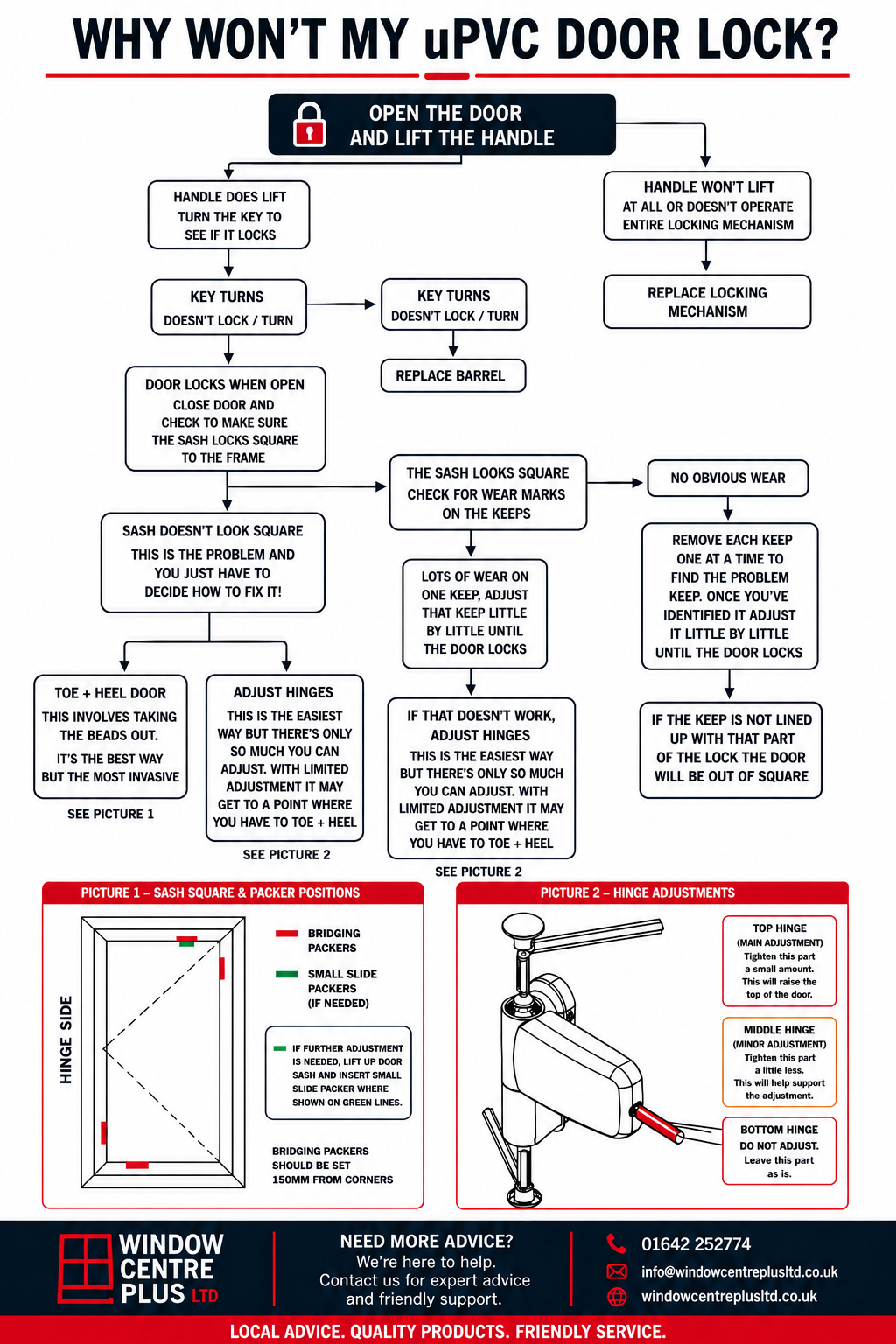
Follow the flow chart below from the start and work through the checks one at a time.
 Tap to open the full-size flow chart
Helpful information
Most uPVC door locking problems come down to one of three things: the locking mechanism itself, the barrel the key turns in, or the door sash sitting out of square in the frame. Working through the chart in order tells you which one you're dealing with.
Sash square & packers (Picture 1). Bridging packers should be set roughly 150mm from the corners. If more adjustment is needed, lift the door sash and insert a small slide packer where the green lines are shown. Toe and heeling involves taking the beads out — it's the most invasive method, but it's the best and longest-lasting fix.
Hinge adjustments (Picture 2). The top hinge is the main adjustment — tighten it a small amount to raise the top of the door. The middle hinge is a minor adjustment to support the change. Do not adjust the bottom hinge. Hinge adjustment is the easiest route, but there is only so much travel available, so you may still end up needing to toe and heel the door.
Only carry out checks you feel comfortable with. If the door is your only secure entrance, or the mechanism or barrel needs replacing, it's best to get expert advice before going further.
Need more advice?
We're here to help. Contact us for expert advice and friendly support — local advice, quality products, friendly service.
Time for a new door?
If your door is beyond adjusting, we manufacture made-to-measure uPVC and composite doors here in Middlesbrough.